
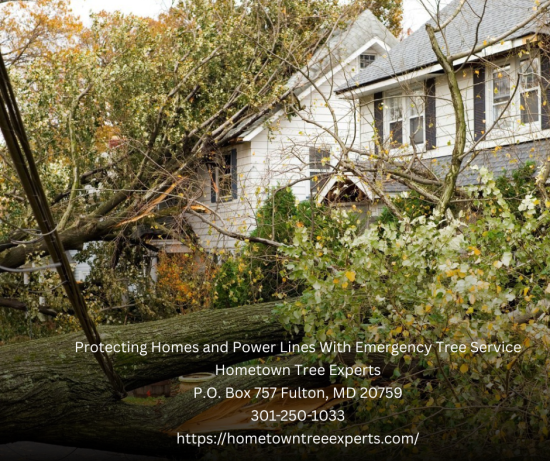
Emergency tree services play a critical role in protecting homes and power lines from potential disasters. Overgrown branches and weakened limbs can cause power outages and property damage. Expert arborists assess tree health and structural integrity to identify and mitigate risks. They use advanced equipment and techniques to safely remove hazardous trees and trim branches near power lines. Regular maintenance reduces emergencies and guarantees safety. Explore further to discover more on effective tree risk management.
Understanding the Risks of Unmanaged Trees
When trees are left unmanaged, they can pose significant risks to property and personal safety. Overgrown branches might interfere with power lines, leading to power outages or electrical fires. Additionally, weakened limbs are susceptible to breaking during storms, causing structural damage to homes and vehicles. The root systems of unmanaged trees can also disrupt underground utilities, resulting in costly repairs. It’s vital to regularly inspect trees for signs of disease or decay, as these conditions weaken structural integrity and increase the likelihood of collapse. Furthermore, unmanaged trees can obscure visibility on roads, contributing to accidents. Professional assessment is essential to identify potential hazards early, ensuring trees are maintained in a way that minimizes risks and maintains a safe environment.
How Emergency Tree Services Mitigate Disaster
Given the potential hazards posed by unmanaged trees, emergency tree services play a vital role in mitigating disaster. They promptly address risks by removing dangerously leaning trees and trimming branches threatening power lines. Utilizing advanced equipment like cranes and chainsaws, they guarantee efficient operations while prioritizing safety. These services reduce the likelihood of trees causing property damage or power outages during storms by swiftly clearing obstructions.
Experienced arborists assess structural weaknesses, identifying trees at risk of falling. Their expertise is essential in high-stakes scenarios where rapid response is needed to prevent accidents. Additionally, they provide post-disaster cleanup, removing debris to restore safe environments. By maintaining vigilance and readiness, emergency tree services safeguard communities from potential tree-related disasters, minimizing harm and disruption.
The Role of Tree Assessment in Preventive Measures
Conducting thorough tree evaluations is essential in implementing effective preventive measures against tree-related hazards. Arborists identify potential risks by evaluating tree health, structural integrity, and proximity to homes and power lines. They examine signs of disease, decay, or pest infestations, which compromise stability. Evaluating root systems and soil conditions provides insight into the tree’s anchorage capacity. By appraising branch density and canopy weight distribution, arborists forecast possible limb failures. Documentation of tree growth patterns aids in predicting future interference with infrastructure. Through regular monitoring, experts detect early warning signs, enabling timely interventions. This proactive approach not only minimizes the likelihood of tree failure but also optimizes safety for homeowners and utility services, thereby reducing emergency response needs and associated costs.
Techniques for Safe Tree Removal and Pruning
Guaranteeing safe tree removal and pruning requires meticulous planning and execution by skilled professionals. They begin by evaluating the tree’s structure, identifying potential hazards like weak limbs or decay. These experts calculate the tree’s fall path, considering surrounding structures and power lines. They use climbing gear and rigging techniques to control the descent of heavy branches, minimizing damage risk. Chainsaws and pole saws are operated with precision, following industry standards for cuts that promote healthy regrowth. Safety gear, including helmets, gloves, and harnesses, is mandatory to protect workers from falling debris. Ground crews clear the area to guarantee no unauthorized access. This systematic approach guarantees trees are removed or pruned safely, reducing risks to property and personnel.
Emergency Tree Services and Power Line Safety
When storms strike or trees unexpectedly fall, emergency tree services play an important role in maintaining power line safety. Professionals assess the situation, identifying risks like dangling branches or uprooted trees threatening electrical infrastructure. They employ specialized equipment such as cranes and bucket trucks to safely remove debris without causing further damage. Technicians are trained to work near high voltage lines, utilizing insulated tools and protective gear to prevent electrocution.
Coordination with utility companies guarantees power lines are de-energized when necessary, minimizing hazards. These experts prioritize restoring service while safeguarding public safety. By adhering to industry standards and employing strategic procedures, emergency tree services mitigate risks, guaranteeing community resilience and reducing power outages. Their precision and expertise are crucial in protecting both infrastructure and human lives.
The Importance of Quick Response in Severe Weather
In the face of severe weather events, a rapid response from emergency tree services is essential to prevent widespread damage and assure public safety. Swift action guarantees fallen trees are promptly removed, reducing the risk of blocked roads and compromised infrastructure. Emergency teams, equipped with specialized tools, strategically assess and mitigate hazards like unstable limbs threatening overhead lines or structures. Their expertise minimizes further damage and restores safe conditions efficiently. Delayed responses can exacerbate risks, potentially resulting in power outages or property damage. By prioritizing quick intervention, these services not only protect critical infrastructure but also enhance community resilience. Timely, expert action is imperative, as severe weather’s unpredictability demands readiness to address evolving threats effectively.
Collaborating With Utility Companies for Optimal Safety
Effective collaboration with utility companies is crucial for maintaining ideal safety during emergency tree service operations. Utility companies possess essential information about power line locations and electrical hazards, enabling tree service professionals to conduct operations safely. By establishing clear communication channels, both parties can coordinate efforts to mitigate risks associated with fallen trees and live wires.
Tree service teams should adhere to established safety protocols, such as maintaining safe distances from power lines and using insulated tools. In addition, utility companies can provide on-site support to de-energize lines when necessary. Properly coordinated efforts guarantee that tree removal activities do not inadvertently cause power outages or compromise worker safety. This collaboration maximizes efficiency, reduces downtime, and safeguards both the community and infrastructure from potential hazards.
Signs Your Trees May Pose a Threat
Although trees are vital to the environment, they can also become safety hazards if not properly maintained. Key indicators of potential threats include dead or decaying branches, which may fall unexpectedly. Inspect for cracks or splits in the trunk, as these structural weaknesses can lead to collapse. Leaning trees, especially those with exposed roots, signal instability. Fungal growth at the base or on the bark often indicates internal decay. Branches too close to power lines or roofs pose significant risks during storms. Trees with sparse foliage or premature leaf loss may suffer from disease or pest infestations. Regular monitoring and prompt action are essential to prevent property damage and guarantee safety, highlighting the need for professional assessment and maintenance.
Choosing the Right Emergency Tree Service Provider
How can property owners confirm they’re selecting the best emergency tree service provider? First, check for proper certification and insurance. Reputable providers should have ISA (International Society of Arboriculture) certification and extensive liability coverage to protect against potential damages. Next, assess their safety protocols. The provider should conduct thorough site evaluations and utilize personal protective equipment (PPE) for all personnel. Additionally, verify their equipment is well-maintained and suitable for the task. Experience is vital; choose a company with a proven track record in emergency tree removal. Request references and read reviews to gauge customer satisfaction. Finally, confirm they offer a prompt response time, as delays can increase risks to property and power lines. Prioritizing these factors guarantees a reliable choice.
Long-Term Benefits of Regular Tree Maintenance
Regular tree maintenance offers numerous long-term benefits that enhance both safety and aesthetics. By systematically pruning and inspecting trees, property owners can markedly reduce the risk of branches falling onto power lines or homes during storms. This proactive approach minimizes emergency situations, ensuring power reliability and structural integrity. Additionally, regular maintenance promotes healthy growth, preventing diseases and pests that could compromise tree stability.
Technicians employ advanced techniques to assess tree health, using tools like resistographs to detect internal decay without invasive procedures. This allows for precise interventions, tailored to each tree’s specific needs. Over time, these practices result in robust trees with well-balanced canopies, reducing wind resistance and the likelihood of uprooting. Consequently, regular maintenance is an essential investment in both safety and environmental sustainability.